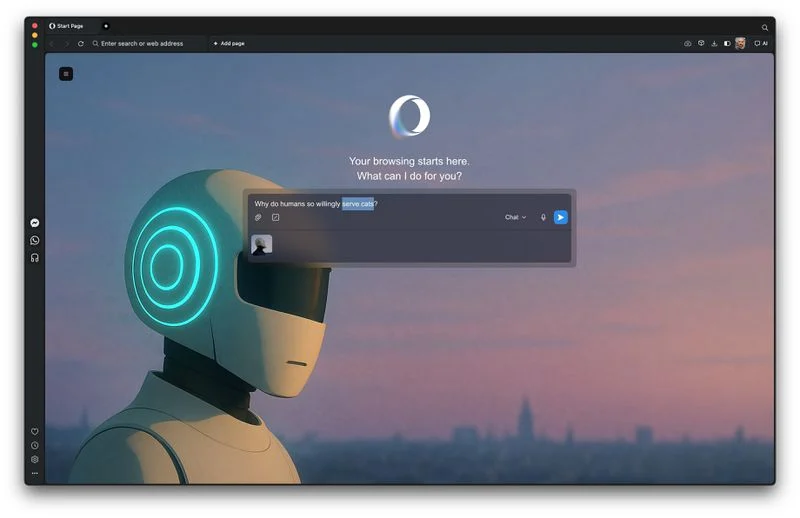
The Opera Neon Agentic Browser is now available to the general public. Opera today officially opened access to the app, removing the previous closed “Founders” phase waitlist that had been in place since the browser’s launch on October 2. This move positions Opera to compete aggressively in the rapidly evolving space of AI-first browsing.
The browser aims squarely at AI power users, redefining the role of the web browser from a passive display tool to an autonomous execution engine. For $19.90 per month, the subscription grants users immediate access to a full suite of agents and a powerful selection of underlying AI models.
Opera Neon Agentic Browser Opens to Public: Pricing and Access
Opera Neon is a significant shift from traditional browsers. Unlike conventional software, Neon leverages AI to execute tasks directly on a user’s behalf. This includes sophisticated actions such as comparing information across multiple sources, opening and closing tabs contextually, and completing complex transactions.
The subscription model confirms Neon’s position as a premium tool. The $19.90 monthly fee buys more than just an interface; it purchases access to top-tier, high-cost foundational AI models. This pricing signals that Opera views Neon as an essential, high-value utility for professionals and users who demand high-level automation in their daily workflows.
Autonomous Task Execution
Neon’s core value proposition is its ability to move beyond simple search. The browser uses its integrated agents to run multi-step tasks autonomously. Specifically, it handles complex commands ranging from booking complete travel itineraries to building basic websites, generating videos, and editing documents, all within the browser environment.
The Core Agents: AI Models Powering the Opera Neon Agentic Browser
The Opera Neon Agentic Browser utilizes a multi-engine selector, giving users access to some of the most advanced models available today. This architecture ensures that the right tool—whether it’s a large language model (LLM) or a specialized media model—is deployed for every task.
Subscribers gain immediate access to:
- Gemini 3 Pro
- GPT-5.1
- Veo 3.1
- Nano Banana Pro
The latter, Nano Banana Pro, is Google’s state-of-the-art image generation and editing model. Consequently, the browser can handle high-fidelity visual design, complex editing, and the creation of accurate diagrams and infographics.
These models complement the three core in-browser agents:
- Chat: Serves as the standard conversational AI experience.
- Do: Focuses on browsing the web to complete specific tasks, such as finding and comparing products.
- Make: Designed for creative and coding tasks, including building simple web apps and generating multimedia content.
Introducing ODRA: The Deep Research Agent
A major addition accompanying the public release is the ODRA (Opera Deep Research Agent) agent.
ODRA is specialized for sustained, in-depth investigation. Instead of providing a simple summary, ODRA can gather and synthesize comprehensive information on complex subjects. Its rapid “1-minute research” mode is particularly notable. This feature quickly produces highly structured insights and, crucially, provides clear sourcing for all information gathered. Therefore, ODRA offers a much faster path to verified, synthesized knowledge, positioning the browser as a premier tool for journalists, academics, and corporate researchers.
Competition in the Agentic Browser Space
The launch of the Opera Neon Agentic Browser into the public domain intensifies competition in the niche, but growing, market for AI-first browsers. Opera faces strong rivals, particularly from companies built entirely on agentic AI principles.
- Perplexity’s Comet Browser: Comet focuses heavily on AI-assisted search and summarization. Its “Do” agent focuses on task completion across tabs and is known for providing clear citations, similar to ODRA.
- The Browser Company’s Dia Browser: Dia distinguishes itself with a custom “Skills” framework. This allows users to create personalized, reusable AI workflows—effectively acting as Siri Shortcuts for the web. Dia also emphasizes personalized, contextual memory.
Ultimately, while competitors like Comet and Dia target similar use cases, Opera Neon differentiates itself through its aggressive integration of a broad suite of leading, high-cost AI models under a single subscription. This strategic offering aims to make Neon the definitive choice for users who want to test the raw, cutting-edge AI technologies as they become available.