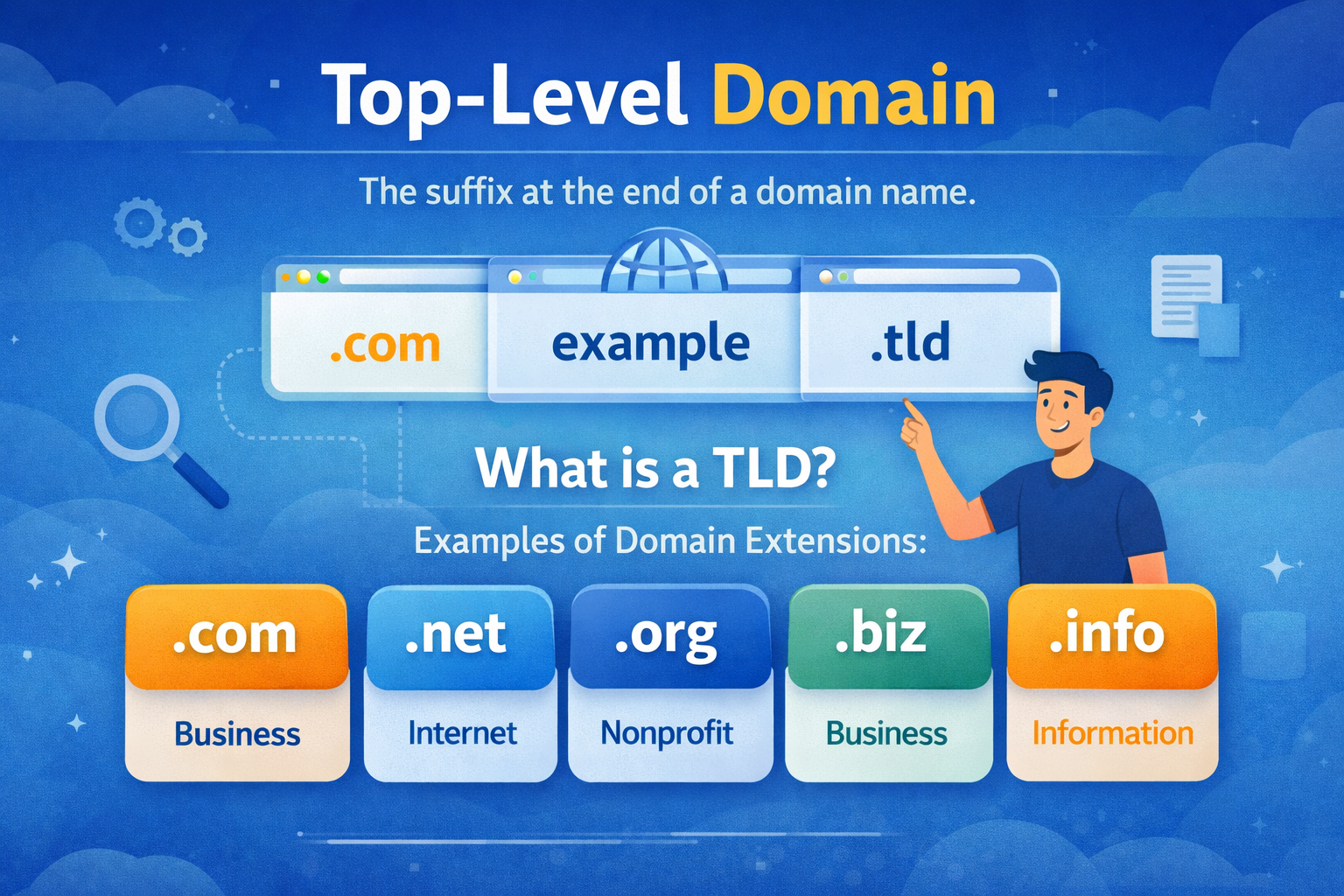
A Top-Level Domain appears as the suffix at the end of a domain name. It sits after the final dot in a web address. For example, in the website address learn2yoga.com, .com represents the Top-Level Domain. This extension helps categorize websites and organize the internet’s domain naming structure.
Anyone building a website should understand the role of a Top-Level Domain. Domain names allow users to reach websites without typing complicated numerical IP addresses. The domain name system organizes these addresses into levels. The Top-Level Domain forms the highest level of this structure.
Every web address follows a structured hierarchy. The Top-Level Domain appears at the end of the address. The main domain name usually sits before it. Together they form a unique online identity.
Consider the domain example.com. In this address, the word example functions as the second-level domain. The extension .com represents the Top-Level Domain. Combined together, they create a complete domain name that directs visitors to a website.
Internet users encounter many types of domain extensions. Domain registrars allow individuals and businesses to choose from hundreds of domain endings. Today, users can select from more than 400 different Top-Level Domain extensions when registering a domain.
The .com Top-Level Domain remains the most widely recognized extension on the internet. Businesses originally used it to represent commercial websites. Over time, individuals, organizations, and global brands adopted it as their primary domain extension. Many users trust websites that use .com because of its long history.
Another popular extension is .net. Technology companies and network providers first used this Top-Level Domain during the early growth of the internet. Today, many organizations use the .net extension as an alternative when their preferred .com domain is unavailable.
Nonprofit organizations often choose the .org Top-Level Domain. Community groups, charities, and educational organizations frequently use this extension. Visitors often associate .org websites with social causes and public service initiatives.
Businesses that want a commercial identity sometimes select the .biz Top-Level Domain. This extension highlights business activity and helps companies create professional domain names. It also provides an alternative when traditional extensions remain unavailable.
Another extension that supports informational websites is .info. Website owners often choose the .info Top-Level Domain when their primary purpose involves sharing knowledge, guides, or educational resources.
Choosing the correct Top-Level Domain can influence how visitors perceive a website. A domain extension often creates the first impression before users even open the site. Many users associate certain extensions with credibility or professionalism.
For instance, many internet users recognize .com as a trusted and widely used extension. Nonprofit organizations often gain credibility when they use .org. Businesses may choose .biz to highlight their commercial activities.
Website owners sometimes struggle to secure their preferred domain extension. Popular domain names often become unavailable quickly. When this happens, owners can explore alternative extensions that still represent their brand effectively.
Domain registration platforms allow users to search for multiple domain names at once. Some services even allow customers to select several domain options within a single order. This flexibility helps website owners secure suitable alternatives.
Many businesses register multiple domain variations to protect their brand identity. They might register different extensions that point to the same website. For example, a company may register example.com and example.net to prevent competitors from using similar names.
Multiple domain registrations also improve accessibility for visitors. Users sometimes type different domain endings when searching for websites. Redirecting those variations to the main domain ensures visitors reach the correct destination.
The internet continues to expand, and new domain extensions appear regularly. Technology groups introduce specialized Top-Level Domain options for different industries and communities. Some extensions target specific sectors such as technology, media, or finance.
These modern extensions allow businesses to create more descriptive domain names. Instead of relying only on traditional extensions, companies can select domain endings that reflect their industry or service.
Despite the rise of new domain extensions, the Top-Level Domain remains a critical component of the internet’s infrastructure. It plays a central role in organizing websites and ensuring users can locate online resources easily.
In summary, a Top-Level Domain represents the final part of a domain name and helps define the identity of a website. Whether a site uses .com, .net, .org, or another extension, the right domain ending strengthens online visibility and improves user recognition across the internet.
READ: What Is a Subdomain