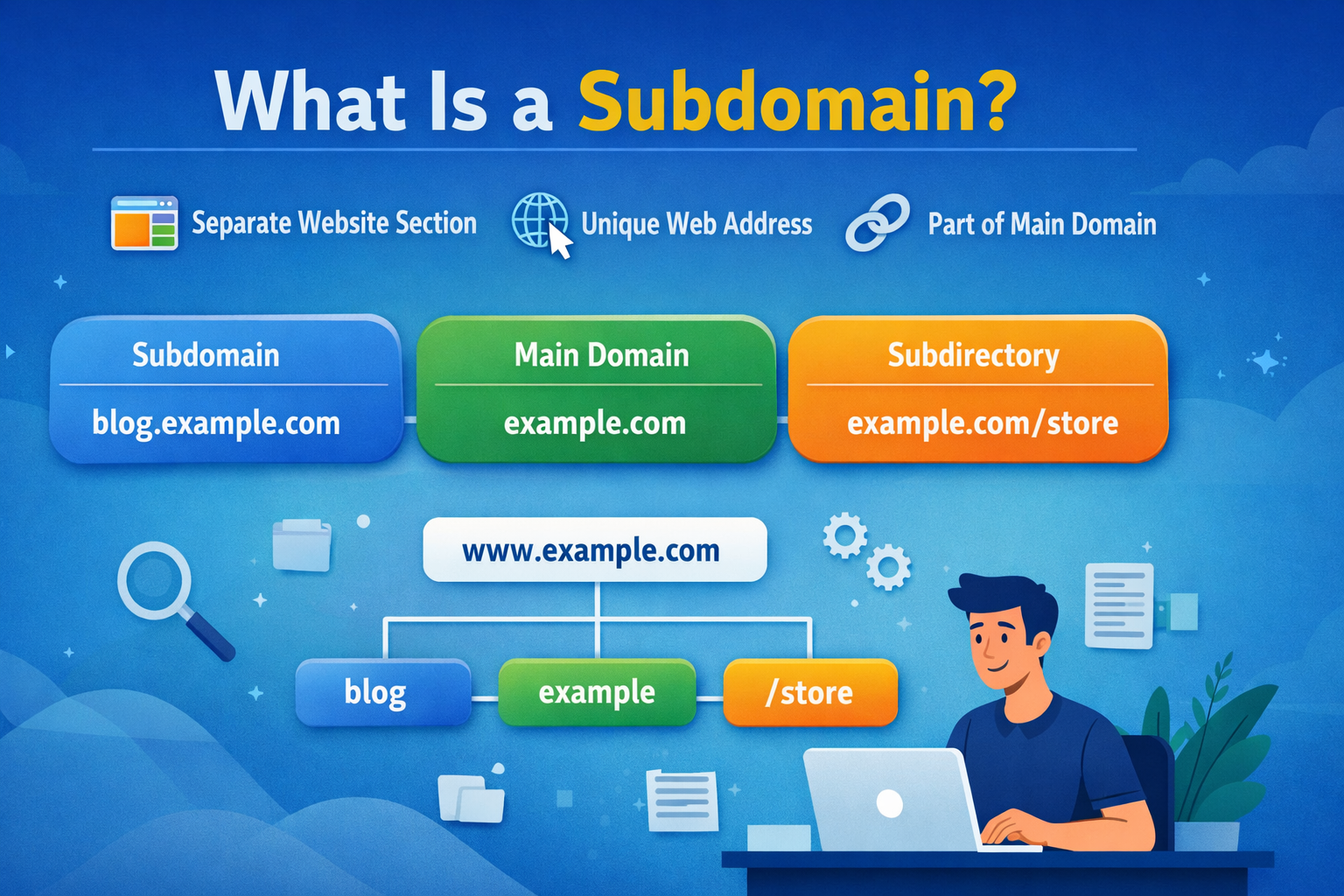
What Is a Subdomain is a common question among website owners, bloggers, and businesses building an online presence. A subdomain is a part of a larger domain that allows website owners to organize their content into separate sections while maintaining the same main domain. It acts like a separate address connected to the primary website.
A subdomain functions as an extension of your main domain name. Instead of creating a completely new domain, website administrators can use a subdomain to organize specific areas of their site. This makes navigation easier for visitors and helps websites manage different types of content efficiently.
Understanding What Is a Subdomain becomes easier when looking at the structure of a website address. A typical web address includes several levels. The main domain sits at the center of the structure, while the subdomain appears before the domain name.
For example, consider the address:
mail.example.com
In this structure, mail represents the subdomain, while example.com represents the main domain. The subdomain creates a unique section within the website without requiring a completely separate domain registration.
To fully understand What Is a Subdomain, it is helpful to compare it with a subdirectory. A subdirectory is a folder located inside the main domain directory. Subdirectories usually appear after the domain name in a web address.
For instance:
example.com/blog
In this example, blog is a subdirectory. It is part of the main website folder structure. By contrast, a subdomain appears before the domain name and functions like a separate web section.
A subdomain would look like this:
blog.example.com
Here, blog becomes its own independent section under the main domain. Even though it belongs to the same website, it operates like a separate environment.
Many large websites use subdomains to organize their services. One well-known example includes email services. Platforms often create separate subdomains for their email systems.
For instance:
mail.yahoo.com
In this case, mail serves as the subdomain that directs users to the email service. The main domain remains yahoo.com, but the subdomain identifies a specific function of the website.
Another common use appears in online platforms offering multiple services. Businesses use subdomains to separate product categories, regional sites, or applications. This structure improves organization and helps users reach specific sections quickly.
A car sales website might use subdomains to separate brands. Instead of placing everything on one page, each brand could receive its own section.
Examples might include:
ford.mycars.com
chevy.mycars.com
In these examples, ford and chevy function as subdomains. Each directs visitors to a dedicated section of the same website.
Understanding What Is a Subdomain also involves knowing how domain levels work. A full website address usually contains several levels.
The structure typically looks like this:
subdomain.domain.com
Each part has a specific role.
The top-level domain (TLD) appears at the end. This includes extensions such as .com, .net, or .org.
The second-level domain is the main domain name chosen by the website owner.
The third-level domain, often called the subdomain, appears before the main domain.
When combined, these elements form a complete web address that directs users to specific locations on a website.
Website owners create subdomains using their hosting control panels. Most web hosting platforms allow users to create multiple subdomains under a single domain. These subdomains can link to different folders or services within the website.
For example, a business might create several subdomains such as:
store.example.com
support.example.com
blog.example.com
Each subdomain serves a different purpose while remaining connected to the main domain.
Another advantage of subdomains is improved website organization. Large websites often contain many sections, products, or services. Subdomains help structure these areas clearly and logically.
For example, an education platform might create separate subdomains for students, teachers, and administrators. This allows each group to access its own interface without confusion.
Subdomains also help developers test new website features. Many organizations create development environments using subdomains. A test version of a website might appear at:
dev.example.com
This allows developers to test updates without affecting the main website.
Security is another benefit related to What Is a Subdomain. Administrators can isolate specific applications or services within separate subdomains. This separation can reduce risk if one section experiences technical issues.
Search engines also treat subdomains as somewhat independent sections of a website. This means subdomains can rank separately in search results. Some businesses use this advantage to create targeted content sections such as blogs, knowledge bases, or support portals.
However, website owners must carefully plan their subdomain structure. Too many subdomains can make a website difficult to manage. It is important to organize them logically and ensure each serves a clear purpose.
Creating subdomains usually requires access to a hosting control panel such as cPanel. Within the hosting interface, administrators can add a new subdomain and assign it to a specific directory. Once configured, visitors can access that section of the website using the new web address.
In summary, understanding What Is a Subdomain helps website owners manage large websites efficiently. Subdomains allow businesses, developers, and content creators to divide websites into organized sections without registering multiple domains.
By using subdomains effectively, websites can improve navigation, enhance user experience, and maintain clear organization across different services and content areas.